

Spermidine is a biological molecule that is capturing ever-growing interest within the international scientific community due to its extraordinary protective properties on human health. Among the most concentrated and interesting natural sources, wheat germ stands out, which is the embryo of the wheat grain (Triticum aestivum L., belonging to the Poaceae family). From a botanical and structural standpoint, the wheat grain is divided as follows:
- 3% Embryo (or wheat germ): the most nutrient-dense fraction, rich in fats, enzymes, vitamins (particularly vitamin E), and minerals; it represents the essential energy reserve for the birth of the new plant and is the biological portion with the absolute highest concentration of spermidine.
- 80% Endosperm: the most quantitatively abundant part, mainly composed of starch and proteins.
- Aleurone layer: a thin protective sheath with high protein value that enwraps the seed.
- Outer hull (or bran): the cortical portion of the grain, extensively rich in insoluble fiber.
Although wheat is one of the cornerstone crops for global nutrition, scientific research shows that its biological value goes far beyond the caloric intake of pasta or flour, proving to be a true ally for cellular well-being.
What is spermidine and where is it found?
From a biochemical perspective, spermidine (N-(3-aminopropyl)-1,4-butanediamine) is a biogenic amine. This molecule is naturally present within all eukaryotic cells, including those of the human body, where it is synthesized starting from the precursor putrescine. However, the concentration of spermidine in human tissues undergoes a physiological and progressive decline with advancing age. Since endogenous synthesis is sufficient only during the early stages of life, exogenous supplementation through the diet becomes a crucial nutritional strategy in older age to maintain the body’s homeostasis.
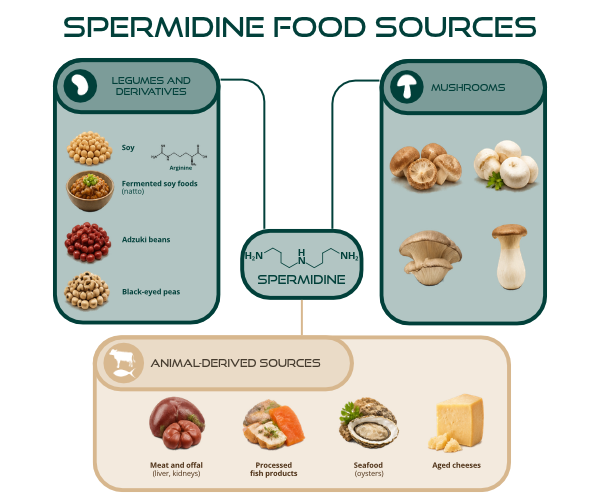
In addition to wheat germ, which stands out as the ideal matrix for commercial extraction and supplementation due to its low content of antinutritional factors, spermidine is distributed in both plant- and animal-derived foods. The main dietary sources include:
- Legumes and derivatives: dried soybeans, adzuki beans, black-eyed peas, and fermented soy-based foods (such as natto). Soy is particularly rich in spermidine thanks to its high content of arginine, a key metabolic precursor of its biosynthesis.
- Mushrooms
- Sources of animal origin: offal (such as liver and kidneys), processed seafood products, shellfish (oysters), and aged cheeses.
Industrial and consumer note: The final spermidine content is strongly influenced by preservation and cooking methods. While boiling and grilling cause a significant degradation of polyamine levels, methods such as microwave cooking or, ideally, sous-vide cooking guarantee its maximum preservation.
Spermidine Health Benefits: Longevity and Immune Defenses
The benefits of spermidine are articulated on two main, highly interconnected fronts: promoting longevity and supporting the immune defenses.
Longevity and mortality reduction: evidence from the Bruneck study
The ability of spermidine to act as a “caloric restriction mimetic” and delay senescence processes is supported by a robust body of preclinical and epidemiological literature. The direct link between the intake of this molecule and human lifespan finds its strongest confirmation in the Bruneck Study, a prospective population-based cohort investigation. This study monitored a sample of 829 participants aged between 45 and 84 over a twenty-year period (from 1995 to 2015). The results published in The American Journal of Clinical Nutrition unequivocally demonstrated that a high dietary intake of spermidine is inversely associated with all-cause mortality. In detail:
- The overall mortality rate drops sharply as the incremental consumption of the molecule increases.
- Subjects with a higher dietary intake of spermidine recorded a significant reduction in the risk of death from vascular diseases and cancer.
- The difference in mortality risk between subjects with high consumption and those with low consumption is significant. It equates to a calculated biological advantage of a whopping 5.7 years of extra youth.
Spermidine therefore actively supports survival, offering multi-organ protection (cardiac, hepatic, and cerebral) and countering cognitive decline.
Immune defense mechanisms and intestinal integrity
The core of spermidine’s mechanism of action lies in its marked ability to induce and reactivate cellular autophagy. Autophagy is a conserved process essential for clearing cells of damaged components, misfolded proteins, and dysfunctional organelles. Since the decline of the autophagic flux is one of the primary causes of the immune system’s aging, spermidine acts by restoring this cellular function, additionally helping to actively engulf and eliminate viruses and bacteria that have penetrated the cells. Beyond autophagy, recent research highlights that spermidine exerts a direct immunomodulatory role, stimulating, for example, the differentiation of T lymphocytes and increasing the abundance of intestinal Treg cells.
Our research group deepened the understanding of spermidine’s protective efficacy precisely at the level of the human intestinal epithelium, one of the organism’s main immune barriers. Using cell models exposed to inflammatory stress induced by lipopolysaccharide (LPS), the study showed that spermidine:
- Vigorously promotes autophagic flux, helping cells to remain active and vital even under inflammatory attack.
- Preserves the integrity of the intestinal barrier, restoring levels of occludin, a cornerstone protein of tight junctions that prevents inflammation-induced intestinal permeability.
- Controls oxidative stress and gene-level inflammatory cascade, significantly reducing levels of reactive oxygen species (ROS) and the expression of Midkine (MDK), an inflammatory marker induced by the NF-kB metabolic pathway that is typically elevated in inflammatory bowel diseases.
- Regulates mucus secretion, normalizing the mucus overproduction caused by inflammatory insults.
Eugedin Complex: the advanced nutraceutical synergy by TGD
To meet the need for safe and efficient integration of this precious polyamine, TGD, in close collaboration with the University of Bologna, has developed Eugedin Complex. This is an ingredient formulated by combining wheat germ with cloves essential oil (Syzygium aromaticum), titrated in eugenol. Cloves boast a solid tradition of medical use as natural antimicrobials and antinflammatories, and the eugenol contained within them acts at a biochemical level by reducing the activation of the inflammasome and the inflammatory signaling pathways mediated by NF-kB.
The study by Truzzi et al. directly tested this specific proprietary combination, demonstrating that the co-presence of spermidine and eugenol amplifies the benefits of the individual components, thereby confirming that the union of polyamines and complementary bioactive complexes enhances their overall health-promoting properties. This formulation exerts a synergistic action: eugenol provides exceptional antioxidant properties and shuts down inflammatory signals, while spermidine restores deep cellular homeostasis by inducing autophagic flux. The formula is completed by the presence of Vitamin D, which is essential for the proper functioning of the immune system against viral and bacterial attacks.
Eugedin Complex therefore stands as a cutting-edge, safe, and science-backed nutraceutical solution, ideal for actively supporting immune barriers, protecting gut health, and promoting healthy cellular longevity.
Read more
- Kiechl S, Pechlaner R, Willeit P, Notdurfter M, Paulweber B, Willeit K, Werner P, Ruckenstuhl C, Iglseder B, Weger S, Mairhofer B, Gartner M, Kedenko L, Chmelikova M, Stekovic S, Stuppner H, Oberhollenzer F, Kroemer G, Mayr M, Eisenberg T, Tilg H, Madeo F, Willeit J. Higher spermidine intake is linked to lower mortality: a prospective population-based study. Am J Clin Nutr. 2018 Aug 1;108(2):371-380. doi: 10.1093/ajcn/nqy102. PMID: 29955838.
- Liu S, Chen B, Yan C, Zhu X, Liu J, Li N, Wang Z, Liu H. Spermidine in food and health: biosynthesis, dietary sources, production, and biological functions. Food Chem. 2026 Aug 30;521:149657. doi: 10.1016/j.foodchem.2026.149657. Epub 2026 May 19. PMID: 42235230.
- Truzzi F, Whittaker A, D’Amen E, Valerii MC, Abduazizova V, Spisni E, Dinelli G. Spermidine-Eugenol Supplement Preserved Inflammation-Challenged Intestinal Cells by Stimulating Autophagy. Int J Mol Sci. 2023 Feb 18;24(4):4131. doi: 10.3390/ijms24044131. PMID: 36835540; PMCID: PMC9964041.
