

The microbiota – gut – brain axis represents one of the most fascinating and promising fields in contemporary biomedical research. It is a bidirectional communication system that connects the gut microbiota, the enteric nervous system, and the central nervous system. This complex network plays a crucial role in maintaining physiological balance and modulating numerous processes, from immunity to mood regulation.
In recent years, attention has focused especially on alterations in the microbiota associated with inflammation, cognitive dysfunction, and neurological disorders. Although many mechanisms are not yet fully understood, it is now evident that gut microorganisms communicate with the brain through multiple integrated pathways, influencing complex functions such as emotions, sleep, memory, pain perception, and energy metabolism.
In this article you can find an overview of the main systems through which the gut ecosystem interacts with the brain.
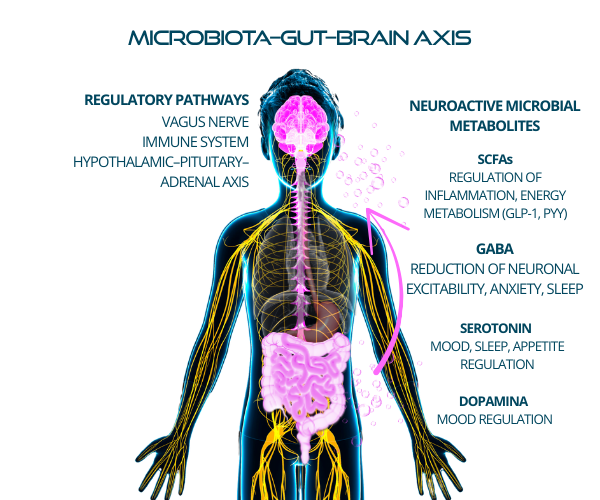
Communication pathways of the microbiota–gut–brain axis
The vagus nerve
The vagus nerve is one of the main communication routes between the gut and the brain. Its afferent fibers can detect metabolic and immune signals such as microbial neurotransmitters, short-chain fatty acids, and cytokines. Physiological or potentially harmful metabolites present in the gut can activate these pathways or cross the intestinal and blood–brain barriers. This affects stress perception, pain, mood regulation, and inflammatory responses.
The immune system
The microbiota profoundly regulates immune activity. Its metabolites and microbial fragments modulate cytokine production. When this communication is altered, as in dysbiosis, systemic inflammation or neuroinflammation can occur, contributing to neurological and psychiatric disorders.
The hypothalamic–pituitary–adrenal (HPA) axis
The HPA axis is the central regulator of the stress response. Its dysregulation is implicated in mood disorders and is often associated with increased cortisol and inflammatory mediators. Neural structures such as the amygdala play a key role in emotional processing. Bacteria can influence its anatomy and physiology, helping explain many emotional and stress-related aspects linked to the microbiome.
Alterations in communication pathways between the microbiota and the brain may trigger inflammatory responses. Certain pathogenic microorganisms produce metabolites that stimulate cytokine production and promote inflammation in the central nervous system, contributing to neurological disorders. Cognitive and emotional dysfunctions may therefore accompany intestinal dysbiosis.
Neuroactive microbial metabolites in the microbiota–gut–brain axis
The balance of the gut microbiota also affects nervous system well-being through the production or modulation of key neurotransmitters—one of the most extensively studied mechanisms.
Serotonin
Serotonin is essential for the regulation of emotions, sleep, appetite, and pain perception. Its precursor, tryptophan, depends partly on the state of the microbiota. About 90% of total serotonin is found in the gastrointestinal tract, and only 10% in the brain.
SCFAs (short-chain fatty acids)
Acetate, propionate, and butyrate are produced by fiber fermentation. They can cross the intestinal and blood–brain barriers, influence neurotransmitter release, and modulate immune function. Butyrate, in particular, is associated with:
- reduced inflammation,
- improved insulin sensitivity,
- regulation of hunger through GLP-1 and PYY.
Dopamine
Dopamine is the most abundant catecholamine in the brain. It is synthesized from dietary tyrosine and crosses the blood–brain barrier. Over 50% of the body’s dopamine is produced in the gut. Certain bacteria, such as Staphylococcus spp., can convert L-DOPA into dopamine.
GABA
GABA is the main inhibitory neurotransmitter, regulating neuronal excitability and influencing mood-related processes.
Many lactobacilli and bifidobacteria synthesize GABA from glutamate. Microbial GABA can cross the intestinal barrier and interact with enteric and vagal receptors, influencing both the central and gastrointestinal nervous systems.
Microbiota, sleep, and neuroendocrine balance
The microbiota influences sleep quality through neurotransmitters involved in circadian regulation. An example is the bacterial production of GABA mentioned above. Clostridium sporogenes contributes to the production of 5-hydroxytryptophan, the precursor of serotonin. Other microorganisms participate in histamine synthesis, which functions as an excitatory neurotransmitter and a regulator of autoimmune reactivity.
Microbiota and neurodegeneration
The microbiota–gut–brain axis plays a significant role in neurodegenerative diseases such as Alzheimer’s and Parkinson’s. Preclinical studies show that dysbiosis may contribute to chronic neuroinflammation, increased oxidative stress, and the buildup of toxic proteins.
In Parkinson’s disease, gastrointestinal symptoms often precede neurological ones by many years, confirming that microbiota alterations can predict cognitive and motor decline.
Microbiota, anxiety, and depression
Chronic inflammation is a key factor in psychiatric disorders. The microbiota contributes to this mechanism by modulating immune activity and metabolite production affecting mood.
Environmental triggers in predisposed individuals may lead to excessive immune activation, chronic inflammation, and the development of neuropsychiatric disorders. Dysbiosis, almost always associated with increased inflammation, can alter serotonin production, a mechanism linked to anxiety and depression.
Microbiota and energy metabolism
An altered microbiota also affects energy metabolism. Many processes related to glucose regulation and appetite are tied to microbial activity.
In metabolic syndrome, reduced levels of butyrate-producing bacteria such as Faecalibacterium and Roseburia are common. SCFAs bind receptors regulating satiety and intestinal motility, stimulating GLP-1 and PYY. Butyrate levels correlate negatively with fasting glucose, while propionate is associated with better insulin sensitivity.
Discover our ingredients for microbiota balance
Gut and brain well-being begins with a balanced microbiota. Explore our natural ingredients designed to support microbiota equilibrium:
- BIOintestil® reduces gut inflammation, supports relaxation, and improves digestive function.

- Limenorm® supports microbiota balance and energy metabolism, particularly glucose management.

- Clovedin® helps control overgrowth of potentially pathogenic yeasts such as Candida spp., often increased in dysbiosis.

For further reading
- Barrio C, Arias-Sánchez S, Martín-Monzón I. The gut microbiota-brain axis, psychobiotics and its influence on brain and behaviour: A systematic review. Psychoneuroendocrinology. 2022 Mar;137:105640. doi: 10.1016/j.psyneuen.2021.105640. Epub 2021 Dec 17. PMID: 34942539.
- dos Santos, A.; Galiè, S. The Microbiota–Gut–Brain Axis in Metabolic Syndrome and Sleep Disorders: A Systematic Review. Nutrients 2024, 16, 390. https://doi.org/10.3390/nu16030390
- Mihailovich, M.; Soković Bajić, S.; Dinić, M.; Đokić, J.; Živković, M.; Radojević, D.; Golić, N. Cutting-Edge iPSC-Based Approaches in Studying Host—Microbe Interactions in Neuropsychiatric Disorders. Int. J. Mol. Sci. 2024, 25, 10156. https://doi.org/10.3390/ijms251810156
