

Pathobionts are integral components of the microbiome’s complex ecological community, which is composed of microorganisms that colonize different niches of the human body. Because environmental conditions vary significantly from one niche to another, the composition of the microbiome differentiates based on localized characteristics such as pH, oxygen availability, and nutrient profiles. (You can find further information about the general microbiome in this article). In this article, we will delve deeper into the roles these microbes play in maintaining eubiosis and driving the onset of dysbiosis
A complex equilibrium
Simplistic communication regarding microbes has led to a polarization, classifying them strictly as either “good” or “bad” based on their beneficial or harmful interactions with the host. This binary view has deeply influenced how we characterize microbial species. However, it is imperative to acknowledge that universally “good” bacteria rarely exist in clinical reality; both the overgrowth and depletion of the same species can be associated with disease pathogenesis.
In fact, the extent and nature of the reciprocal interaction between host and microbiota dictate whether a given bacterium remains harmless or promotes disease under specific conditions. Gut commensals, which typically reside harmlessly in the gastrointestinal tract, can trigger opportunistic infections under certain circumstances, either through their own overgrowth or by creating environments that favor other pathogenic bacteria.
What are pathobionts?
Emerging evidence suggests that interactions between microorganisms and their host are far more nuanced than this binary classification in good or bad microorganisms. This has given rise to a new concept and terminology: “pathobionts”. A “pathobiont” is a symbiont capable of inducing disease only under specific genetic or environmental changes in the host. While healthy physiological conditions prevent commensal bacteria from causing infection, altered host states can generate a microenvironment that favors pathobiont colonization and subsequent infection. There are different factors that influence the transition from commensal to pathogenic behavior in pathobionts: colonization fitness, pathoadaptive mutations, and evasion of host immune response. Other factors that influence this behaviour include:
- Antibiotics play a crucial role in combating infectious diseases and have significantly advanced healthcare, greatly increasing human life expectancy. Despite that, antibiotic-modified bacterial community structure promotes the proliferation of pathobionts. Overuse and misuse of antibiotics modulate microbial composition, elevate the levels of pathobiont density, and may be the cause of infection, thus emphasizing the importance of judicious antibiotic use.
- Dietary factors play a significant role in the transition from commensal to pathogenic behaviour, disrupting homeostasis and triggering an inflammatory response. For example, iron plays a crucial role in improving gut microbial composition and modulating inflammatory pathways. From a dietary perspective, both iron deficiency and iron supplementation can alter microbial ecology. Iron deficiency generally reduces beneficial commensals and impairs immune regulation, whereas excess dietary iron in the gut lumen can favour oxidative stress processes and the overgrowth of pathobionts.
- An impaired immune status may create the conditions for pathobionts to express pathogenic tracts, driving inflammation, infections and disease development. An excessive immune reaction to a pathobiont can destabilize immune homeostasis, leading to pathological conditions. The potentials of gastrointestinal commensals to trigger opportunistic infections are associated with a dysregulated or weakened immune defenses against infection.
- Genetic variations may promote pathobionts emergence through the intensification of a persistent inflammatory state. This mines immune defenses efficacy. Beyond host genetic susceptibility, bacterial pathoadaptive mutations also play a key role in
Commensal microbes may aid pathogenic bacteria in increasing their colonization capacity through indirect mechanisms. Therefore, otherwise harmless and beneficial commensals can play a critical role in establishing opportunistic infections.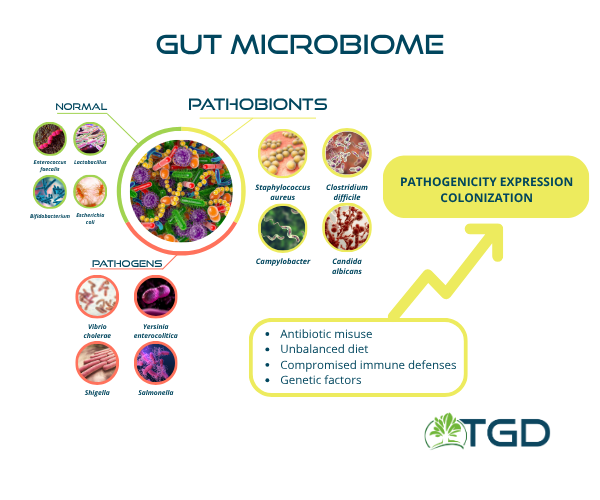
Strategies for eubiosis maintenance and pathobionts control
Microbiomes differ not only between body niches but also exhibit high interindividual variability. This means that there is no standard recipe for eubiosis. Nevertheless, common dysbiotic patterns are frequently observed in gastrointestinal, metabolic, and neurological diseases, with a reduction in short-chain fatty acid (SCFA) -producing microbial clusters being a primary feature. SCFAs, including acetate, propionate and butyrate, play an important role in reducing gut pH, restricting pathogen and pathobiont growth, and providing energy for colonocytes, to support gut barrier repair and reduce systemic inflammation. To increase the abundance of SCFA producing clusters, there are different strategies:
- Prebiotics are indigestible fibers commonly found in raw fruits, vegetables, cereals and legumes that specifically promote the proliferation and function of advantageous microorganisms such as Bifidobacterium and Lactobacillus species. These are generally soluble fibers that enhance the formation of SCFAs during microbial fermentation. Prebiotics increase SCFA signaling via G-protein coupled receptors on epithelial and immune cells, which suppress pathobiont virulence gene expression and fortify mucosal defense.
- Plants metabolites, such as essential oils, act as broad spectrum antimicrobials and have multitarget mechanisms that have demonstrated to be able to modulate gut microbiome composition by reducing the overgrowth of pathobionts and promoting SCFA producing strains abundance.
Read More
- Bharathi S, Soundara Rajan YAPA, Prakash S, Immanuel G, Ramasubburayan R. Pathobionts in the microbiome: Drivers of disease and targets for treatment. Microb Pathog. 2026 Feb;211:108268. doi: 10.1016/j.micpath.2025.108268. Epub 2025 Dec 27. PMID: 41461285.
- Tewari N, Dey P. Navigating commensal dysbiosis: Gastrointestinal host-pathogen interplay orchestrating opportunistic infections. Microbiol Res. 2024 Sep;286:127832. doi: 10.1016/j.micres.2024.127832. Epub 2024 Jul 3. PMID: 39013300
