

Inflammatory pain, especially in its chronic form, is a debilitating pathological condition. It drastically reduces the quality of life. It stems from inflammatory processes, even low-grade ones, related to natural aging and various types of diseases.
In recent years, the global community has begun to consider it a disease in its own right and no longer just a symptom. Epidemiological statistics suggest that chronic pain affects 10% of the world’s population. In Europe, one in four adults suffers from it, while in the United States, the figure exceeds one in five adults (more than 20%). Among the most common pathologies leading to chronic pain are:
- Arthritis
- Fibromyalgia
- Interstitial cystitis
- Migraine
- Vulvodynia
Various traditional pharmacological therapies exist for pain management. However, these are not curative. They also cause long-lasting side effects of varying severity. This scenario drives the growing demand for alternative treatments capable of offering effective support while limiting adverse effects. The study of plant derivatives has shown that certain natural compounds can provide valuable help in chronic pain conditions.
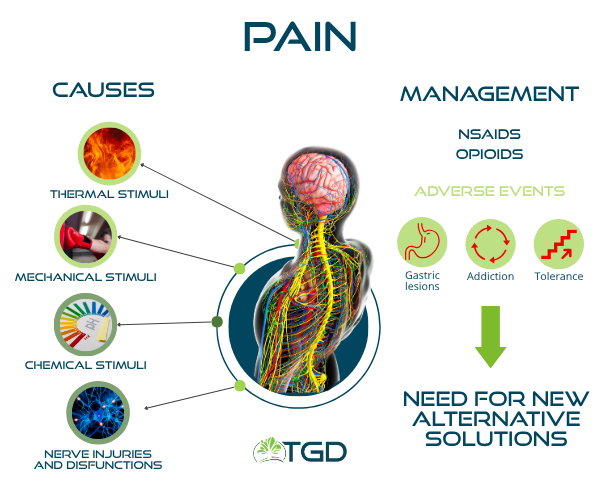
How Pain Begins and Spreads in the Body
The body perceives pain through special nerve cells called nociceptors. These cells are found in specific nerve fibers and ganglia. According to modern “Pain Theory”, pain perception, neuroplasticity, and central sensitization are not isolated phenomena. Instead, they constitute a continuum of the inflammatory response. When tissues suffer damage, the immune system activates immediately. Immune cells use receptors called Toll-like (TLR) to communicate with neurons. This dialogue creates a vicious cycle that triggers spontaneous pain and high sensitivity even to light stimuli.
A precise sequence of biochemical events occurs in the damaged areas: mast cells release immediate inflammatory substances. These trigger the innate response and act as a chemotactic stimulus for other immune cells, such as neutrophils and macrophages. In particular, the more macrophages arrive, the stronger the inflammation and pain become.
Nerve support cells (Schwann cells) also change shape. They begin to produce substances that fuel pain, such as the growth factor NGF and the protein TNF-alpha. This creates an inflamed environment full of molecules that work synergistically to amplify pain.
Neuroinflammation and the Role of the Brain
Pain does not stop at the periphery of the body. It also changes how the spinal cord and the brain read signals. This process involves glial cells, such as microglia and astrocites. Microglia initiate chronic pain, while astrocytes maintain it over time.
The conductor of this process is the TLR4 receptor. When this receptor is activated in the spinal cord, glial cells release more inflammatory molecules. This increases the excitability of neurons and turns off the body’s normal defenses.
Central nervous system diseases (such as multiple sclerosis or Alzheimer’s) follow this same pattern. Mitochondrial dysfunction produces free radicals and increases sensitivity to pain. Therefore, the resolution of inflammation is not a passive event. It is an active biochemical process that medicine and nutraceuticals can guide.
The Role of Plant Derivatives and the Multitarget Approach
To turn off neuroinflammation, an approach capable of hitting multiple targets at once is needed. Traditional drugs block a single pathway, while plant derivatives offer a synergistic action on multiple targets. In recent years, research has focused on cannabinoid receptors. The CB1 receptor is found in the brain and produces psychotropic effects. The CB2 receptor, however, is found on immune cells in the periphery. Activating CB2 reduces pain safely and without psychoactive effects.
From this perspective, Clove essential oil (Syzygium aromaticum) is well characterized. In particular, two main components, beta-caryophyllene and eugenol, manage to modulate the inflammatory cascade, interact directly with the CB2 receptor, and exert a neuroprotective effect.
This solution, combined with omega-3s, and specifically docosahexaenoic acid (DHA), offers a perfect synergy. In fact, DHA integrates into cell membranes. In this way, it diverts upstream the biochemical processes from which inflammation mediators originate, steering the body toward the production of compounds with less inflammatory action compared to those originating from omega-6 fatty acids, such as arachidonic acid.
Algistat: The Innovative Ingredient for Pain Management
To meet the demand for effective solutions against chronic pain, TGD has developed Algistat, the perfect natural answer for developing next-generation nutraceutical products.
It is a functional and standardized ingredient based on Clove Essential Oil and DHA. Unlike traditional remedies, Algistat has a multitarget effect with a positive impact on the management of neuroinflammation through the endocannabinoid system.

Read more
Ceccarelli I, Fiorenzani P, Pessina F, Pinassi J, Aglianò M, Miragliotta V, Aloisi AM. The CB2 Agonist β-Caryophyllene in Male and Female Rats Exposed to a Model of Persistent Inflammatory Pain. Front Neurosci. 2020 Aug 18;14:850. doi: 10.3389/fnins.2020.00850.
Omoigui S. The biochemical origin of pain–proposing a new law of pain: the origin of all pain is inflammation and the inflammatory response. Part 1 of 3–a unifying law of pain. Med Hypotheses. 2007;69(1):70-82. doi: 10.1016/j.mehy.2006.11.028. Epub 2007 Jan 19. PMID: 17240081; PMCID: PMC2766416.
Spigarelli R, Spisni E, Magalhães M, Cabral C, Gonçalves AC, Saracino IM, et al. Clove Essential Oil as a Source of Antitumoral Compounds Capable of Crossing the Blood–Brain Barrier: A Focus on the Effects of β-Caryophyllene and Eugenol in a Glioblastoma Cell Line. IJMS. 2024;26:238. https://doi.org/10.3390/ijms26010238
